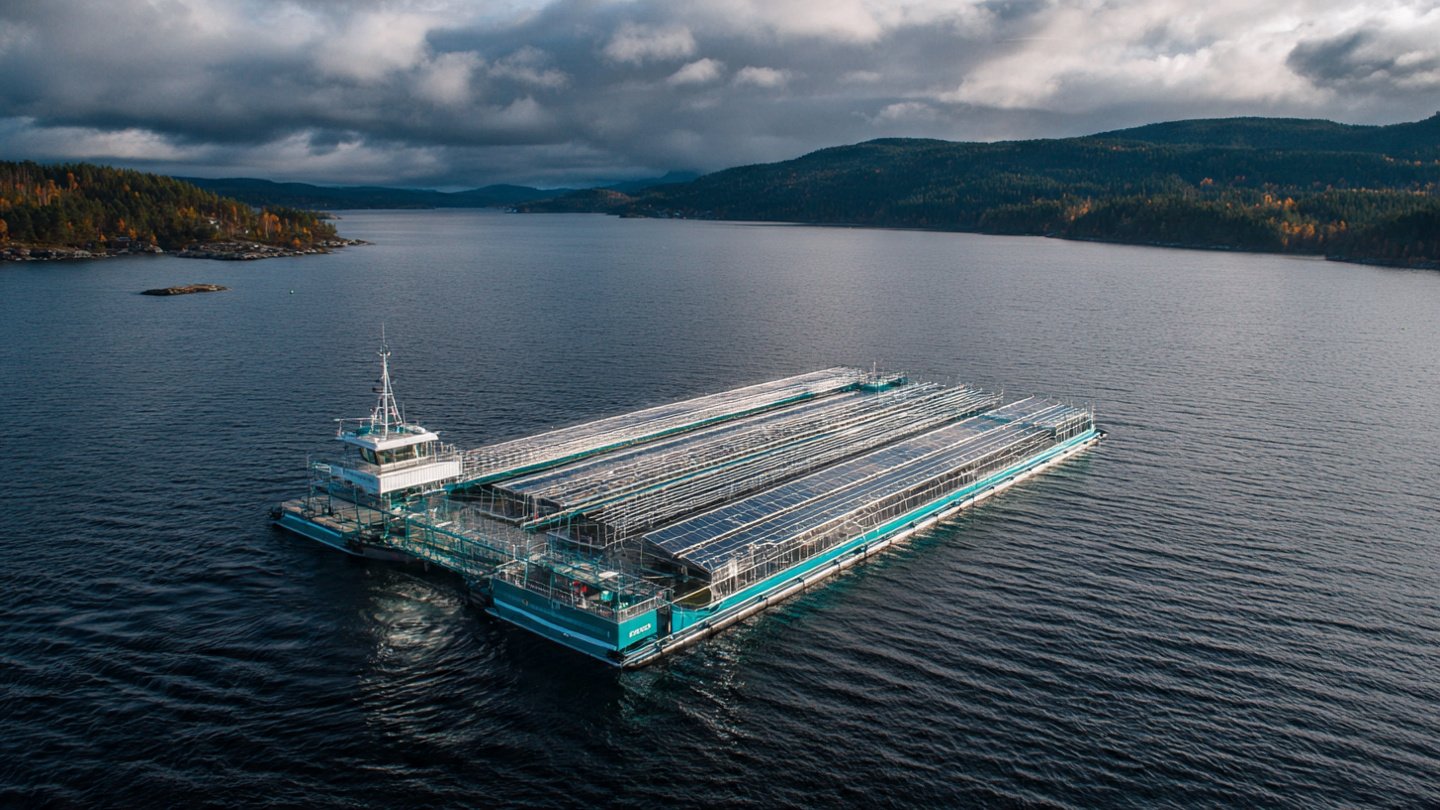
If you spot a massive steel structure on the horizon that looks like a giant ship—even longer than most cruise liners—you’re not imagining things. What appears to be a stationary seafaring vessel is in fact Havfarm, a revolutionary offshore salmon farming platform anchored off the coast of northern Norway. Despite its scale and ship‑like appearance, this floating structure is not designed for navigation or travel; it’s a purpose‑built offshore aquaculture installation developed to redefine how salmon is farmed at sea.
At approximately 385 metres long and nearly 60 metres wide, Havfarm is the largest offshore salmon farm ever constructed—an immense, semi‑submersible frame capable of housing vast quantities of Atlantic salmon in open‑ocean conditions. Its sheer size challenges traditional ideas about aquaculture, blending innovative engineering with the needs of a growing global demand for seafood.
From Fjords to the Open Sea: Why Offshore Salmon Farming?
For decades, salmon farming was carried out in sheltered coastal fjords, where calm water made operations simpler but brought significant environmental challenges. These nearshore pens often suffered from waste buildup, disease and parasite outbreaks, and issues with water quality—all of which could impact wild fish populations and sensitive ecosystems in relatively enclosed waters.
Havfarm’s design aims to address some of those constraints by moving salmon farming farther offshore, into stronger currents and deeper, cleaner waters. In these environments, natural water flow helps disperse waste more effectively, lower the risk of disease transmission, and reduce the prevalence of parasites such as sea lice—problems that have plagued traditional coastal farms.
A Closer Look — Not a Ship, but a Floating Farm
At first glance, Havfarm might easily be mistaken for a ship because of its sheer length and presence on the water. But unlike a vessel, it is anchored to the seabed with massive steel piles and is essentially a stationary aquaculture platform. It remains fixed in place, facing the open ocean’s weather and wave patterns rather than cruising across them.
Above the waterline, the structure looks like a long, low industrial pier floating on the sea. But below you’ll find six enormous submerged net pens—each tens of metres deep—where salmon swim in vast volumes of water, more akin to their natural habitat than the cramped enclosures found in older farms.
These net pens allow fish more room and better water exchange, which can improve welfare and reduce stress. Automated systems monitor oxygen levels, water temperature, and feed distribution, enabling efficient, high‑tech management from shore or nearby control hubs.
Vast Production Capacity and Design Features
Havfarm is not just large in appearance—its functional capacity is equally impressive. Designed jointly by Norwegian engineers and aquaculture specialists, it can house up to 10,000 tonnes of salmon at a time, making it one of the most productive aquaculture platforms in existence.
The structure includes:
- Six giant net pens, each descending deep into cold offshore waters
- A framework strong enough to endure high seas and rough weather
- Automated feeding systems calibrated to maximise efficiency and reduce environmental impact
- Real‑time monitoring for fish health, water quality, and currents
- Mooring systems that secure the platform against shifting winds and tides
The modular design combines principles from both aquaculture and offshore engineering, borrowing safety and stability standards from marine structures such as oil platforms, yet tailored for fish farming.
How It Works — The Daily Reality of Offshore Farming
On a day‑to‑day basis, operations on Havfarm look nothing like a traditional fishing vessel or coastal farm. Fishing boats typically travel to their site, circle enclosures, and deploy feed manually. But on this massive offshore platform, technology handles much of the routine. Feeding is guided by underwater sensors and controlled systems that release precise amounts of feed into each pen based on fish behavior and water conditions.
Underwater cameras give biologists a view of salmon in three dimensions, helping them track how fish are responding to environmental conditions and feed. Automated systems can adjust feeding rates to minimise waste and ensure proper nutrition.
Engineers and technicians monitor water oxygen levels, temperatures, and current speed to promote optimal salmon welfare. Maintenance crews periodically inspect nets and cages for wear or potential escape points. It’s a blend of industrial aquaculture, marine biology, and advanced monitoring—far removed from the image of a simple fish pen beneath a sailboat.
Why Havfarm Matters — Feed the World or Industrialise the Ocean?
Aquaculture has rapidly become a critical source of seafood globally. Today, more than half of the world’s seafood is produced on farms rather than caught in wild fisheries. As populations grow and demand for protein rises, expanding salmon farming capacity becomes increasingly important—especially in sustainable, lower‑impact settings.
Supporters of offshore farms like Havfarm argue that moving into deeper water can reduce environmental pressure on coastal ecosystems. Here, strong currents disperse waste, cooler water lowers parasite loads, and the risks associated with confined nearshore pens are mitigated.
Critics, however, caution that scale alone doesn’t erase environmental concerns. Waste still exists, feed dynamics affect underwater ecosystems, and escaped farm fish can interact with wild populations. Offshore conditions introduce new management challenges and ecological trade‑offs that must be understood and carefully managed.
Engineering at the Edge — Facing the Open Ocean
Building and operating a giant structure like Havfarm in open sea conditions is no small feat. The platform must withstand strong currents, large waves, storms, and corrosive saltwater environments—all factors that make offshore construction both costly and technically demanding.
Compared with traditional coastal farms sheltered in fjords, this open‑water installation requires structural engineering similar to that used in offshore oil platforms. Anchor systems, flexible framework designs, and redundant safety systems are all part of ensuring the facility remains secure and functional in harsh maritime conditions.
In many ways, Havfarm is a test case for how far aquaculture technology can push boundaries—asking whether the next generation of fish farms will be close to shore or set among waves and wind.
A Glimpse Into the Future of Food Production
Havfarm might not look like a typical farm, and it certainly isn’t a ship—but it represents a bold experiment in feeding a hungry world while trying to preserve marine ecosystems. Whether this model becomes the standard for future offshore aquaculture remains to be seen, but it stands as one of the most ambitious engineering and food‑production projects ever built at sea.
At 385 metres long, this floating platform sits poised between ecosystem innovation and industrial ingenuity, capturing a fascinating moment in the evolution of how humans grow and harvest food in a world where wild harvests alone can no longer meet demand.