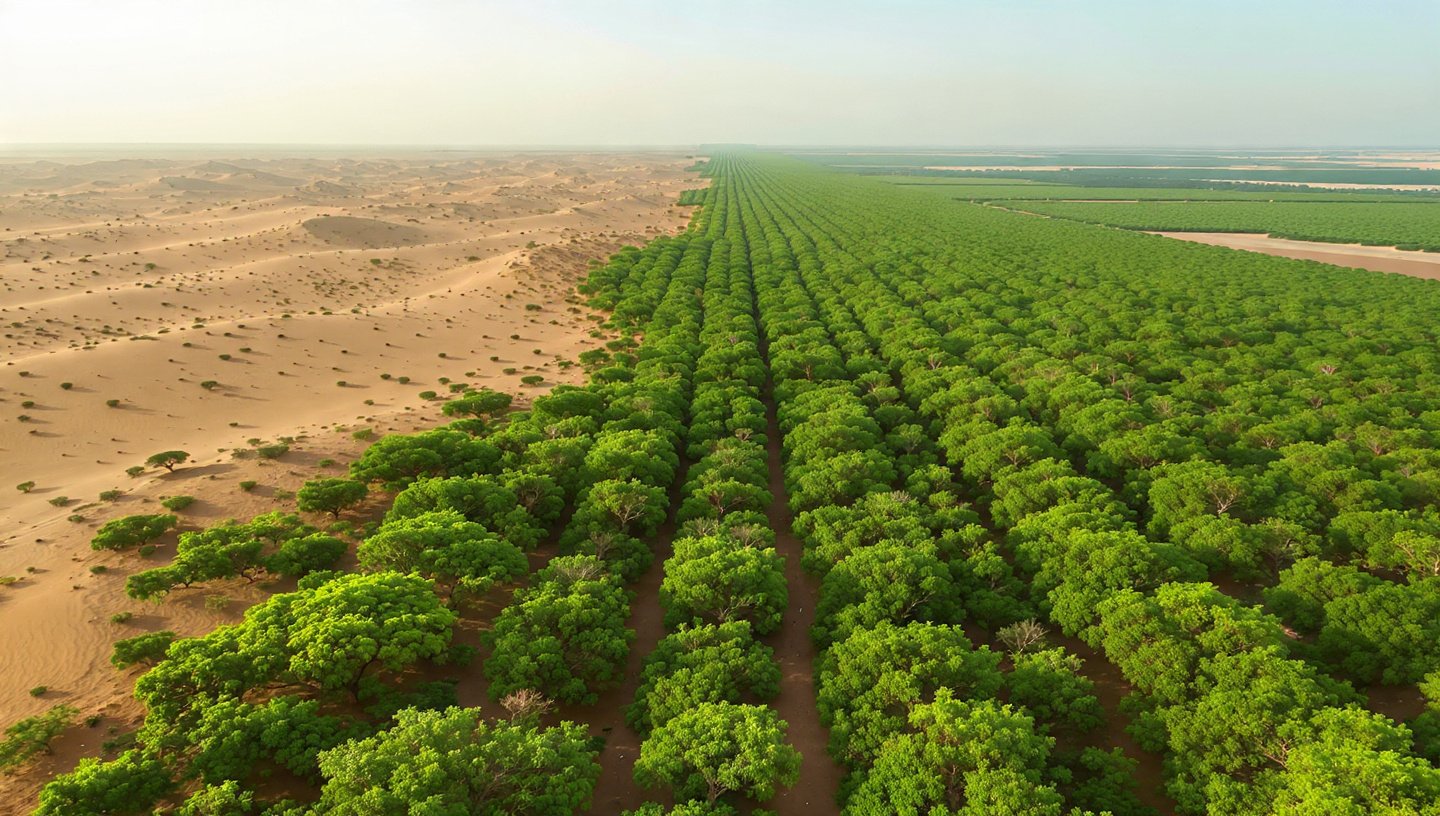
Across the vast expanse of northern China, where golden sand dunes roll toward the horizon and the wind carries grit like dust in its breath, a different kind of frontier battle is being fought. Instead of soldiers and steel, the defenders here are saplings and shrubs, fragile green against a backdrop of relentless desert. This is the story of China’s “Great Green Wall,” one of the most ambitious environmental engineering projects in human history — a monumental effort to slow the advance of the desert through the planting of tens of billions of trees and other vegetation.
The Vision Behind the Wall
The roots of China’s Great Green Wall trace back to the late 1970s, with the launch of the Three‑North Shelterbelt Program — a sprawling afforestation and ecological restoration effort aimed at halting or reversing the encroachment of the Gobi and Taklamakan deserts. Nearly five decades on, the project has grown into a sweeping network of vegetation stretching thousands of kilometers across the country’s northern landscapes. So far, more than 66 billion trees have been planted, with plans to add many billions more by 2050.
The goal is as bold as it sounds: create a living barrier to stabilize soil, act as a windbreak against blowing sands, reduce the severity of dust storms that periodically turn city skies orange, and mitigate the worst effects of desertification. In ideal form, the Great Green Wall would transform barren terrain into productive land, protect communities and farmlands from erosion, and even help sequester carbon — contributing to broader climate goals.
Growing a Forest in the Sand
In places like the edge of the Tengger Desert, planting trees is a battle against harsh realities: glaring sun, scant rainfall, nutrient‑poor soil, and wind that can bury saplings in minutes. Workers lay down checkerboard grids made of straw or brush to slow shifting sands and provide micro‑anchors for new plantings. Into these grids go hardy species adapted to dry conditions, including local shrubs and drought‑tolerant pines, planted in staggered belts rather than uniform lines to better resist the forces of wind and scarcity.
This is not an overnight task. Every sapling planted is a small bet against powerful natural forces. In areas with almost no irrigation, survival rates for young trees can be low, and many die before ever establishing deep roots. Early generations of planting often relied on fast‑growing monocultures — such as poplars — that looked dramatic in reports but struggled to thrive long‑term, especially without substantial water.
Successes and Transformations
Despite these challenges, the Great Green Wall has achieved measurable results. Satellite imagery and on‑the‑ground monitoring show increased vegetation cover around many desert margins, and in some cases, areas formerly dominated by sand have developed enough plant life to stabilize soils and reduce dust storms. In the case of the Taklamakan Desert, massive tree planting has even contributed to turning its edges into a functional carbon sink, helping pull carbon dioxide out of the atmosphere during the growing season.
The broader ecological impacts are complex. China’s overall forest cover has risen significantly over the past few decades, contributing to a greener landscape and providing some relief from land degradation. In areas adjacent to cities and farmlands, shelterbelts and windbreaks protect soil and crops, demonstrating how strategic vegetation can serve local communities.
Beyond ecological effects, the project has also become an economic and social force. Forestry‑based jobs, new agricultural opportunities, and even ecotourism have emerged in previously desolate regions, offering livelihoods where there were few before.
Criticisms and Limitations
Yet despite these achievements, the Great Green Wall is far from a simple success story. One of the most significant criticisms concerns water use. Trees, even drought‑tolerant ones, consume water — and in regions where annual rainfall can be extremely low, drawing down limited groundwater to support plantations can exacerbate water scarcity. In some areas, afforestation has pulled down water tables, making conditions even more challenging for both vegetation and local communities.
Ecologists also raise concerns about biodiversity. Early planting strategies focused on a narrow range of tree species — often non‑native — that created monocultures rather than rich ecosystems. These plantations may be more vulnerable to pests, diseases, and climate stress, and they offer limited habitat for native wildlife compared to natural forests or mixed shrublands.
Moreover, some scientists caution that while tree planting can help slow desertification locally, it does not tackle the deeper drivers of land degradation — such as unsustainable farming practices, overgrazing, and climate change itself. Without addressing these factors, the battle against expanding deserts is likely to continue indefinitely.
Evolving Strategies for Greater Impact
In response to lessons learned, China’s afforestation strategies have been evolving. Instead of merely planting rows of trees, newer approaches emphasize diverse plantings — including grasslands, shrubs, and scattered woodlands tailored to local conditions — which use less water and support more resilient ecosystems. Techniques such as sand‑trapping grids, drought‑tolerant groundcovers, and even integrating solar farms to provide shade and reduce evaporation are part of a more nuanced toolkit to combat desertification.
These innovations reflect an understanding that ecological restoration is not about imposing uniform solutions across diverse landscapes but about working with the environment to build resilience. The goal is less a perfect forest and more a mosaic of land uses that can slow erosion, improve soil health, and provide benefits to both nature and people.
A Global Model with Local Complexities
China’s Great Green Wall has also inspired similar initiatives worldwide, most notably the “Great Green Wall” in Africa — a continent‑spanning effort to curb the Sahara’s southward advance. While contexts differ, the central idea remains the same: use vegetation to bind the land, protect soils, and foster ecological resilience.
However, the lessons from China’s experience are cautionary as much as inspirational. Large‑scale planting can be powerful, but its long‑term success depends on understanding hydrology, biodiversity, land use patterns, and community needs in each region. Environmental engineering must go hand‑in‑hand with sustainable land management and policies that support both nature and the livelihoods of those who live there.
Looking Ahead
As China pushes toward the official end of the Three‑North Shelterbelt Program in 2050, the Great Green Wall will stand as a monumental experiment in ecological restoration — neither complete success nor outright failure, but a work in progress that has already reshaped vast areas of land. If its legacy can be one of adaptive learning, integrating scientific insight with grassroots stewardship, it may offer valuable lessons for the global fight against desertification.
In the arid frontier where sand once seemed unstoppable, the tentacles of green offer not just hope, but a reminder that restoring the environment is a long, complex endeavour — requiring patience, creativity, and an unwavering commitment to living landscapes that nurture both people and planet.