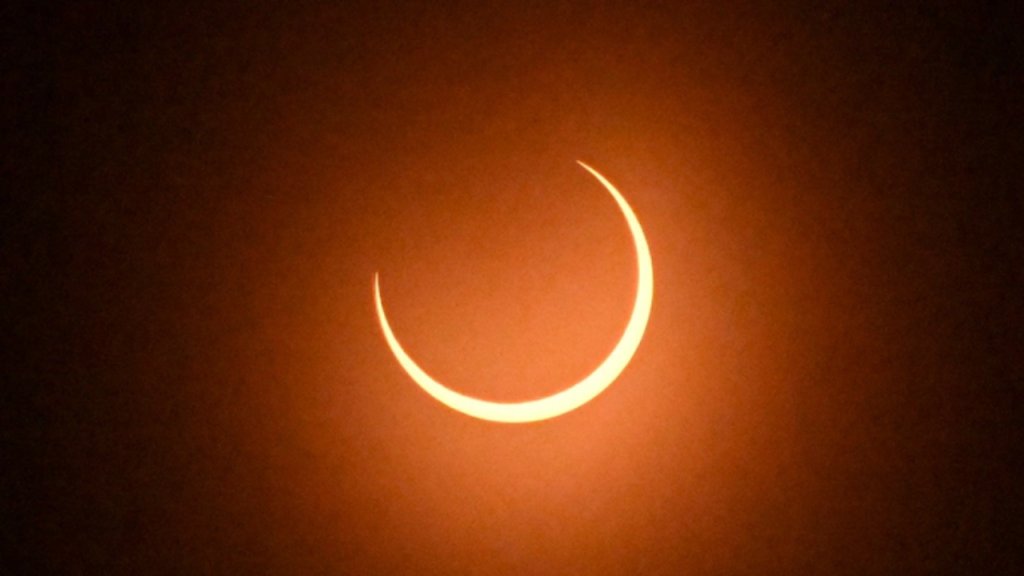
On February 17, 2026, skywatchers across parts of the world will witness a rare and captivating astronomical event: the first annular solar eclipse of the year. On this day, the Sun will briefly dim as the Moon passes directly in front of it—but not completely. Instead of total darkness, a dramatic “ring of fire” will appear in the sky, offering a powerful reminder of the dynamic celestial mechanics that govern our solar system.
This event is not just another eclipse. It marks the first annular solar eclipse of 2026 and sets the tone for a year filled with notable sky phenomena.
What Is an Annular Solar Eclipse?
An annular solar eclipse occurs when the Moon aligns between the Earth and the Sun but is too far from Earth to completely cover the Sun’s disk. As a result, a bright ring of sunlight remains visible around the Moon’s silhouette, creating the iconic annular appearance.
Unlike a total solar eclipse, the Sun is never fully obscured during an annular eclipse. Daylight does not turn to night, but the sky noticeably dims, shadows sharpen, and the atmosphere takes on an unusual quality that many observers describe as eerie and unforgettable.
Why the Sun Will Appear to Dim
The dimming effect during an annular eclipse happens because a large portion of the Sun’s light is blocked. Although the remaining ring is still extremely bright, the reduction in overall sunlight is enough to be perceptible to the human eye and environment.
During peak annularity:
- Light levels drop significantly
- Temperatures may dip slightly
- Animals and birds may behave differently
- Shadows appear sharper and more defined
Even without total darkness, the experience is unmistakably different from a normal day.
Where the Eclipse Will Be Visible
The path of annularity for the February 17, 2026 eclipse will pass over remote regions, including parts of Antarctica and surrounding oceanic areas. Observers located directly along this narrow path will see the full “ring of fire” effect.
A much wider region across the Southern Hemisphere will experience a partial solar eclipse, where the Moon covers only a portion of the Sun. In these areas, the dimming will be noticeable but less dramatic.
Because of the eclipse’s trajectory, it will be less accessible to large populations compared to some past eclipses—but that does not diminish its scientific or symbolic significance.
A Date of Astronomical Importance
February 17, 2026 holds special importance for astronomers and eclipse enthusiasts. As the first annular solar eclipse of the year, it serves as a reminder of the precision with which celestial bodies move.
Solar eclipses follow predictable cycles, such as the Saros cycle, which allows astronomers to calculate eclipse events centuries in advance. This predictability contrasts beautifully with the emotional impact eclipses continue to have on people, even in an age of advanced science.
Safety: How to Observe the Eclipse Properly
Even during an annular solar eclipse, the Sun remains dangerously bright. Looking directly at it without proper eye protection can cause permanent eye damage.
Safe viewing methods include:
- Certified solar eclipse glasses
- Solar filters on telescopes or binoculars
- Indirect viewing methods like pinhole projectors
Ordinary sunglasses are not safe for eclipse viewing. Because the Sun is never fully covered during an annular eclipse, there is no moment when it is safe to look at the Sun with the naked eye.
Why Annular Eclipses Matter to Science
Beyond their beauty, annular solar eclipses are valuable scientific events. They allow researchers to study:
- The Sun’s brightness and limb darkening
- Atmospheric changes caused by reduced sunlight
- Public response and awareness of astronomical phenomena
Although total eclipses provide more opportunities to study the solar corona, annular eclipses still contribute meaningful data to solar and atmospheric science.
Cultural and Historical Perspectives
Throughout history, eclipses have inspired awe, fear, and wonder. Ancient civilizations often interpreted them as omens or messages from the gods. While modern science explains eclipses with precision, their emotional impact remains powerful.
Even today, eclipses bring people together—whether through organized observation events, online livestreams, or personal moments of quiet reflection under a darkened sky.
What Makes This Eclipse Special
While annular eclipses are not as rare as total eclipses, each one is unique due to:
- Its geographic path
- Its timing
- Its visibility conditions
The February 17, 2026 eclipse is particularly notable because it occurs early in the year and over some of the most extreme and remote environments on Earth. It highlights how celestial events unfold regardless of human boundaries or accessibility.
Preparing for the Next Eclipses of 2026
This eclipse is only one of several notable astronomical events scheduled for 2026. For dedicated skywatchers, it serves as a starting point—an invitation to pay closer attention to the sky in the months ahead.
Many astronomy organizations will use this event to educate the public about eclipse safety, orbital mechanics, and upcoming eclipses that may be visible from more populated regions.
A Reminder of Our Place in the Cosmos
When the Sun dims on February 17, 2026, even briefly and far from most population centers, it will symbolize something profound. These events remind us that our planet is part of a vast, moving system—precise, predictable, and endlessly fascinating.
Eclipses connect science and emotion, mathematics and myth, reminding humanity that despite technological progress, the sky still has the power to inspire awe.
Conclusion
The first annular solar eclipse of 2026, set for February 17, will bring a striking celestial display as the Sun briefly dims behind the Moon’s silhouette. Though visible in full annularity only from remote regions, its significance resonates globally.
Whether watched directly, followed through scientific coverage, or reflected upon symbolically, this eclipse marks an important moment in the astronomical calendar. It is a quiet yet powerful reminder that even predictable cosmic events can still leave us humbled—looking upward, once again, in wonder.