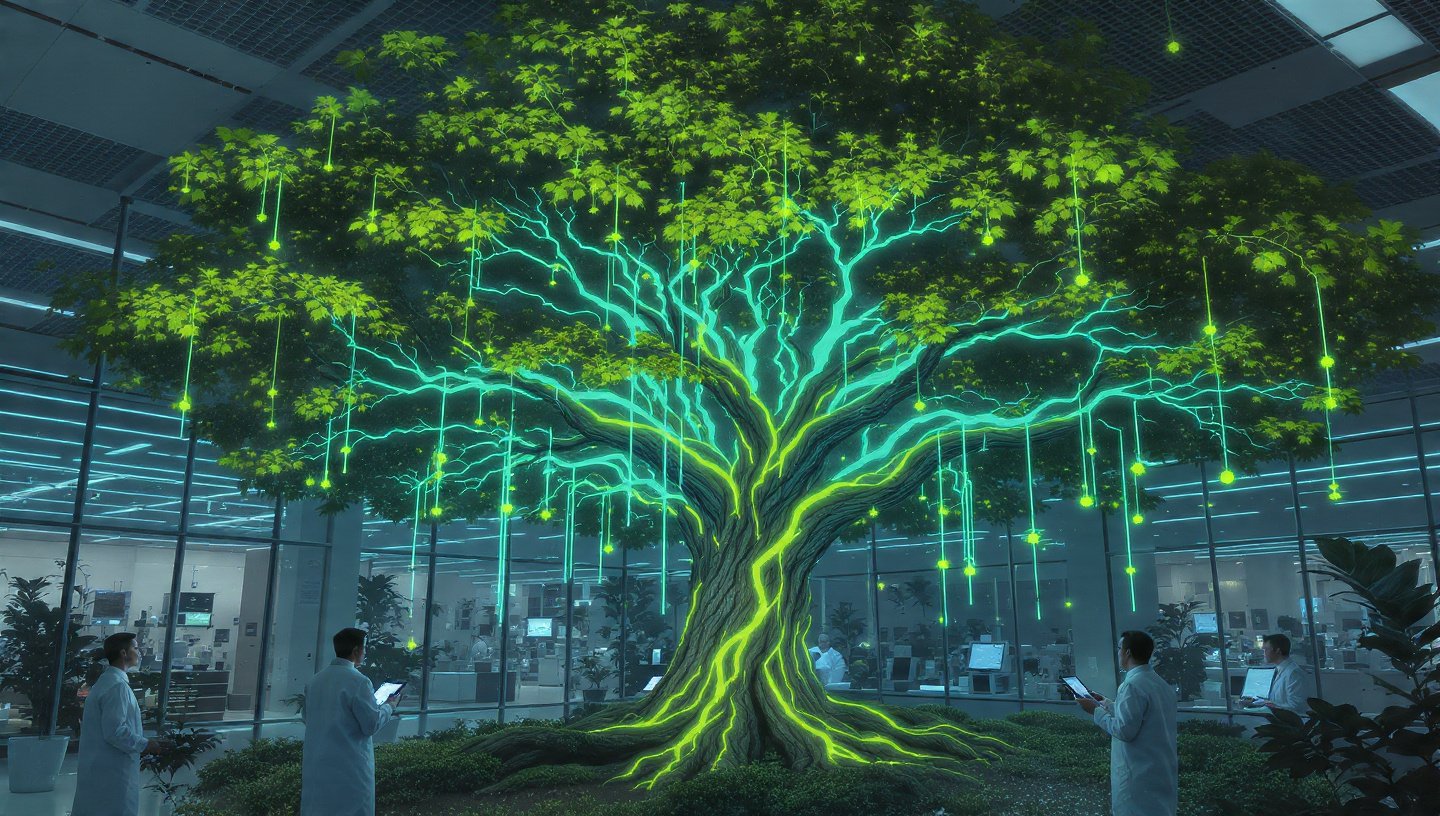
Imagine walking through a forest where every rustling leaf and gentle breeze isn’t just part of nature’s soundtrack—but also quietly generating electricity. This once‑fanciful idea is moving closer to reality thanks to innovative research on “hybrid trees” that could one day function like living batteries. By combining plant biology with advanced materials, scientists are exploring ways to harvest energy directly from trees without harming them—a concept that has the potential to transform how we think about renewable energy.
The Bold Concept: Harvesting Energy From Leaves
At the heart of this research is a surprising insight: leaves aren’t just passive parts of a tree. With their broad surface area and constant motion—from wind, rainfall, or even a simple touch—leaves represent a source of mechanical energy that could be tapped and converted into usable electricity. Scientists at the Italian Institute of Technology (IIT) have been experimenting with the idea of hybrid trees, where biological structures are integrated with tiny functional materials that can generate electric charges when the leaves move.
This process draws on a physical phenomenon called the triboelectric effect, which occurs when two different materials make and break contact, transferring electrical charges in the process. By embedding nanostructured polymers into plant tissues, researchers have effectively turned leaves into tiny electrical generators. Each engineered leaf can produce significant electrical voltage—enough to power small devices or light up LEDs in controlled experiments.
The remarkable part of this technology is that the leaves continue their natural functions, including photosynthesis. That means a hybrid tree could generate electricity without disrupting its role in the ecosystem. In effect, such a tree would produce energy simply by being alive and exposed to natural forces like wind or rain.
How the Technology Works
The basic principle behind hybrid tree technology involves layering or integrating piezoelectric or triboelectric materials with natural leaf tissue. Piezoelectric materials generate electric charge when they are mechanically deformed. When leaves bend or flutter—whether from gusts of wind or raindrops—these materials convert that mechanical motion into electrical energy.
Early demonstrations have shown that even connecting a few hybrid leaves to a simple circuit can generate enough voltage to power tiny LED bulbs without needing traditional batteries or electrical infrastructure. While these experiments are small in scale, they illustrate the potential of scaling up to larger energy‑harvesting systems.
Why This Could Be Revolutionary
There are several reasons why turning trees into living energy producers could be transformative:
- Distributed Clean Energy: If implemented at scale, forests, city parks, and urban green spaces could serve as decentralized power sources, contributing to local renewable energy production without requiring solar panels, wind turbines, or fossil fuels.
- Eco‑Friendly Energy Harvesting: Unlike traditional power infrastructure, hybrid trees integrate with existing ecosystems without creating visual clutter or heavy industrial footprints. They remain aesthetically natural while generating power quietly and passively.
- Potential for Remote Use: In remote areas without reliable electricity, hybrid trees could provide enough energy to power environmental sensors, communication equipment, and even basic lighting solutions.
- Enhanced Smart Cities: Urban green spaces could serve dual functions—improving air quality and urban aesthetics while also contributing to energy networks that support low‑power devices or help distribute small amounts of electricity across communities.
Technical Challenges Still Ahead
Despite its promise, hybrid tree technology is not yet ready for commercial or widespread deployment. Several hurdles remain:
- Efficiency and Output: The amount of energy individual leaves can generate is still quite limited. Current prototypes work well enough to power LEDs or small sensors, but scaling this to even household electricity levels would require significant improvements in material science and energy conversion techniques.
- Material Durability: The nanomaterials and polymers integrated into plant tissue must withstand daily environmental stress—sunlight, rain, wind, temperature swings—without degrading prematurely. Ensuring long‑term functionality without harming the tree is a major engineering focus.
- Grid Integration: Even if hybrid trees could generate useful power, systems would be needed to collect, store, and distribute this electricity effectively—whether through localized grids, microgrid systems, or new types of bio‑energy infrastructure.
Other Nature‑Inspired Energy Technologies
The idea of harvesting energy from living plants is part of a broader trend in sustainable energy research. Scientists around the world are exploring complementary approaches that draw inspiration from nature:
- Bio‑Solar Cells: Researchers have developed living devices using plants or plant tissues that act like tiny solar cells, converting sunlight directly into electrical current. Experiments with succulents, for example, have demonstrated voltage output from real leaves connected into a circuit.
- Hydrovoltaic Leaf Generators: Other teams have created prototypes that capture electricity from leaf transpiration (the natural release of water vapor), opening the door to continuous energy generation from plant processes.
- Tree‑Inspired Devices: Engineers have also designed artificial “trees” with flexible leaves or solar‑capturing surfaces that generate electricity when they move or are exposed to light—mimicking the natural motion and function of plant leaves.
These parallel efforts highlight how biological inspiration can lead to next‑generation sustainable energy technologies that go beyond solar panels or wind turbines.
Ethical and Environmental Considerations
As with any innovation that combines technology with living organisms, hybrid trees raise ethical questions. Could modifying plant tissues for energy production affect plant health or accelerate leaf or stem wear? How might scaled deployment impact biodiversity or ecosystems? These are active areas of investigation, and researchers emphasize that ensuring environmental safety is a priority.
Moreover, careful regulation and ecological studies will be needed to avoid unintended consequences, such as hybrid trees outcompeting natural flora or altering habitats in subtle ways.
A Glimpse Into the Future
Turning trees into living batteries may sound like science fiction, but research suggests it might be a future part of our renewable energy landscape—especially for low‑power, distributed applications. While not a replacement for high‑output energy sources like solar farms or wind arrays, hybrid tree technology complements these systems by adding natural, decentralized energy generation that blends seamlessly with the environment.
Imagine future urban parks where leaves not only clean the air but also power nearby benches or lighting. Picture remote forests doubling as natural sensor grids for environmental monitoring. With continuing advances in materials science, ecology, and energy harvesting, this leafy vision of the future may be closer than you think.