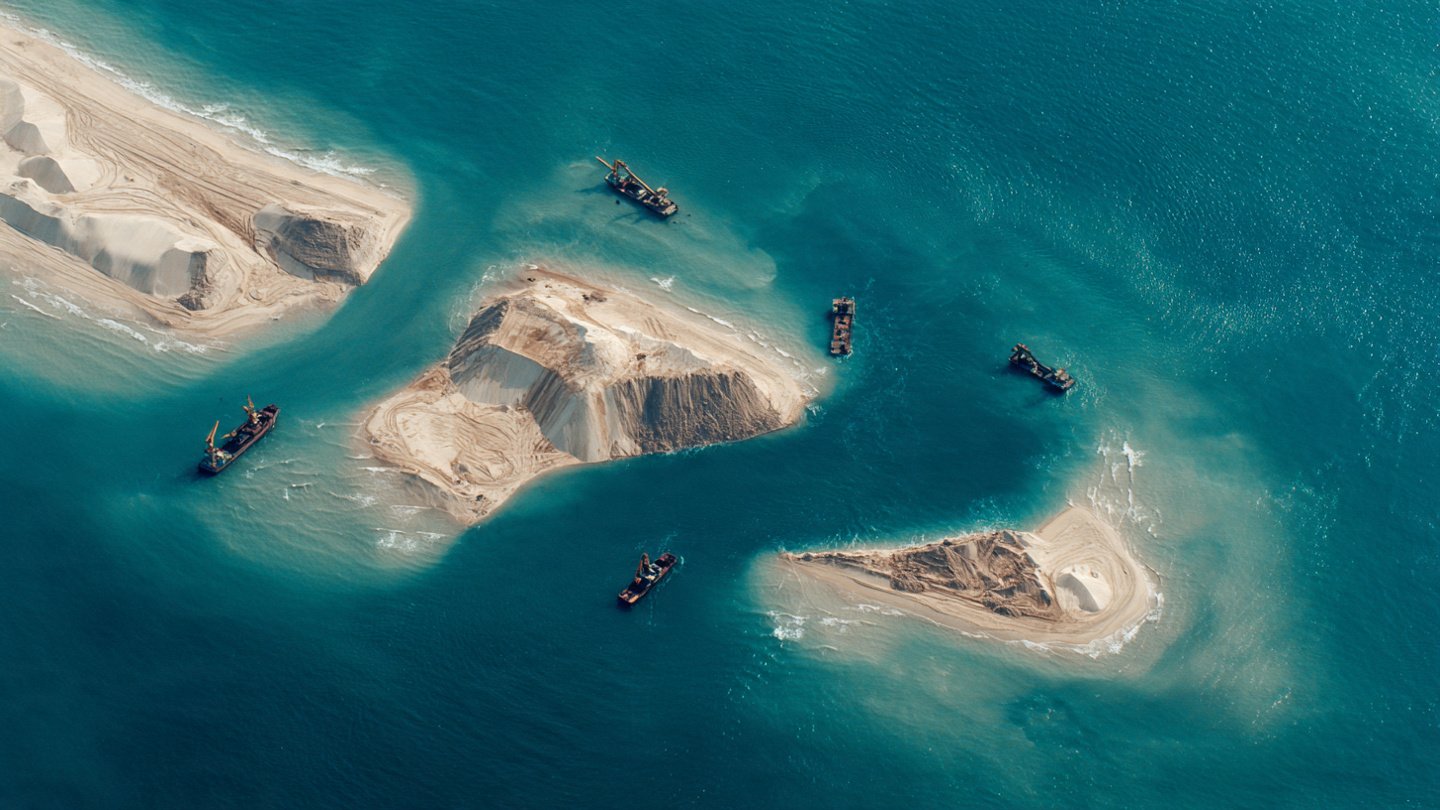
Over the past decade, China’s ambitious program of constructing artificial islands in the South China Sea has drawn global attention — not just for its geopolitical implications but for the dramatic physical transformation it has brought to the ocean landscape. Using enormous quantities of sand and sediment dredged from the seabed, China has dramatically reshaped reefs and shallow waters into permanent land where there once was only ocean. The process works on a physical and engineering level, but its long‑term consequences — ecological, legal, and geopolitical — pose deep and enduring instability for the region.
How the Islands Are Physically Built
Artificial island construction begins with dredging: powerful ships equipped with suction pumps scrape up sand, coral, and sediment from the seabed — often right off reefs or shallow banks — and transport it to designated shallow areas. Once enough material is pumped into place, it is shaped, compacted, and eventually capped with concrete, rocks, or protective layers to form a stable, above‑water landmass.
This is no small engineering feat. In the South China Sea, China has built up to around 3,200 acres of new land — hundreds of hectares — on submerged reef structures in a matter of years by systematically dumping and compacting sand and sediment. By late 2016, large swathes of the Spratly Islands were transformed from low‑lying reefs into flat plateaus capable of supporting runways, ports, and military facilities.
From an engineering standpoint, this works because:
- Sand and sediment can be compacted to provide a stable base once securely contained and reinforced. This mimics land reclamation projects seen around the world.
- Reef platforms and shallow sea floors offer a natural starting point, reducing the depth that needs to be filled and making the project more cost‑effective.
- Heavy machinery and dredgers can move millions of tonnes of material, creating landmass faster than natural sedimentation could ever achieve.
In theory, with enough investment and ongoing maintenance, such reclaimed land can remain stable and support infrastructure like airstrips or communications installations.
The Short‑Term Appeal: Nations Want Territory
China’s motivations for island building are largely strategic. By creating and consolidating land in contested waters, Beijing seeks to solidify its claim over vast sections of the South China Sea — an area through which a large share of global maritime trade passes and which is believed to hold significant natural resources like oil and gas. These newly created islands are not merely symbolic; they enable expanded military patrols, radar placements, airstrips, and facilities that boost surveillance and power projection.
This transformation from sand and sea into functional territory gives China a physical presence in disputed regions, but it also creates tangible geopolitical tension. Rival states such as the Philippines, Vietnam, Malaysia, and Brunei contest these territorial claims, arguing that many of these structures were built within their own exclusive economic zones as defined under the United Nations Convention on the Law of the Sea (UNCLOS). A 2016 arbitration tribunal in The Hague ruled against China’s expansive territorial claims, but Beijing rejects the court’s authority.
Why It Creates Long‑Term Environmental Instability
While physically possible, building islands this way exacts a heavy ecological cost that may not be reversible. Coral reefs — some of the most biologically diverse ecosystems on Earth — are destroyed in the process of dredging and sand pumping. Once reefs are buried under meters of sediment, their complex three‑dimensional structures are lost, along with the countless species that depend on them.
The environmental consequences extend beyond the immediate footprint of the new land:
- Suspended sediment spreads for kilometres, blocking sunlight and suffocating coral and seagrass communities.
- Smothered reefs cannot easily recover, meaning long‑term loss of biodiversity and habitat.
- Altered water flows and currents can change local erosion and sedimentation patterns, affecting nearby shorelines and ecosystems.
A 2019 scientific study using satellite imagery revealed increases in water backscatter — a sign of suspended sediment — over large areas during construction at Mischief Reef. The disruption affected marine life far beyond the artificial land itself and likely contributed to declines in reef health and surrounding fisheries essential to local coastal communities.
These environmental impacts are not just immediate; they are long‑term and, in many cases, irreversible, because coral takes decades or centuries to build reef structures that took millions of years to form naturally. Once buried, the topography and biology of reef ecosystems are fundamentally altered.
Why It Creates Legal and Geopolitical Instability
The legal and geopolitical instability around China’s island building stems from conflicting territorial claims and competing interpretations of international law. Under UNCLOS, nations have rights within their exclusive economic zones — generally up to 200 nautical miles from their coast. Artificially creating land in these zones does not confer legal sovereignty in the same way naturally occurring territory does, yet China uses these features to assert broader territorial rights.
This has led to prolonged disputes with ASEAN countries, particularly the Philippines. Attempts by claimant states to resolve issues diplomatically have yielded mixed results, and some legal rulings — such as the 2016 arbitration — have been dismissed by China, worsening the impasse.
Moreover, these artificial islands have become militarised outposts. Satellite images and defense analyses indicate that China has installed airfields, radar systems, and missile platforms on some reclaimed areas. These installations extend China’s reach and complicate freedom of navigation and regional security arrangements. Such actions feed a cycle of regional mistrust and military competition, drawing in external powers like the United States, which conducts “freedom of navigation” operations to challenge expansive claims.
Long‑Term Instability: Beyond Environment and Geopolitics
The consequences of China’s island‑building extend into economic and social instability for coastal communities across Southeast Asia. Disruption of reef ecosystems undermines local fisheries, which are a major source of food and livelihood for people in countries like the Philippines and Vietnam. Once fish stocks decline due to habitat loss and sedimentation, economic hardship follows, leading to strain on communities and potential competition over remaining resources.
Additionally, artificially created land may not remain stable indefinitely. Reclamation over soft seabed can be susceptible to subsidence — gradual sinking — and shifting sediments. Without careful engineering and ongoing maintenance, landfills that were once above water could settle unevenly, creating structural challenges and environmental hazards. This means that the very islands intended to project power could face physical degradation over time as well.
Conclusion
China’s artificial island‑building — turning seabed into sand‑based land — demonstrates the physical feasibility of large‑scale land reclamation. With massive amounts of sediment and engineering capital, it is possible to turn reef flats into airfields, ports, and military bases within a few years.
However, this physical success masks a range of long‑term instabilities. The environmental damage to coral reefs and marine ecosystems appears largely irreversible. Legal challenges under international law point to contested territorial claims that fuel geopolitical tensions. And socio‑economic impacts on fisheries and coastal communities add another layer of lasting instability in the region. Reconciling these physical achievements with sustainable, peaceful coexistence remains one of the most complex challenges in the South China Sea today.