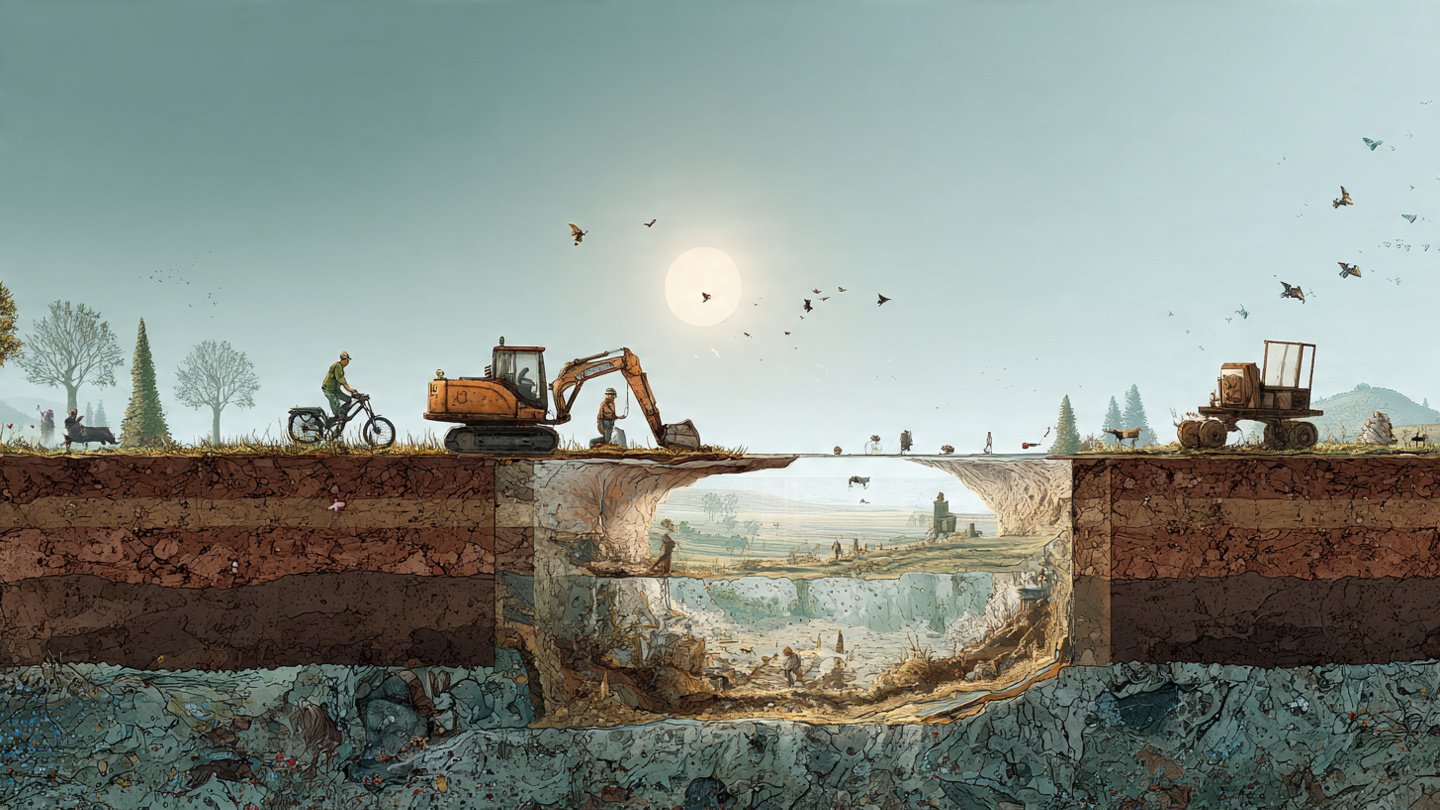
Soil is far more than a surface to walk on or a medium for plants to grow. Beneath our feet exists a complex, living ecosystem filled with organisms that support plant growth, regulate water, cycle nutrients, and store carbon. Yet this underground world is easily disrupted. One of the most damaging and often overlooked threats to soil life is compaction.
When soil becomes compacted, air pockets disappear, water struggles to infiltrate, and life below ground begins to fade. But when compaction is reduced, something remarkable happens: underground life returns—sometimes faster than expected. Understanding how this process works reveals why soil restoration starts not with fertilizers, but with structure.
What Is Soil Compaction?
Soil compaction occurs when soil particles are pressed tightly together, reducing pore space. This usually happens due to repeated pressure from heavy machinery, vehicles, livestock, or even frequent foot traffic.
Compacted soil becomes:
- Dense and hard
- Poorly aerated
- Slow to drain
- Difficult for roots and organisms to penetrate
Over time, compacted soil loses its ability to support healthy plant growth and underground biodiversity.
Why Compaction Is So Harmful to Underground Life
Healthy soil contains a balance of solid particles, water, and air. Underground organisms—from earthworms and beetles to fungi and bacteria—depend on that balance to survive.
When soil compacts:
- Oxygen levels drop
- Water stagnates or runs off
- Root systems shrink
- Microbial activity slows
Without air and space, soil organisms suffocate, starve, or migrate elsewhere. The soil may still look intact from above, but below the surface, biological activity collapses.
The Hidden World Beneath the Surface
Living soil is one of the most biodiverse ecosystems on Earth. A single teaspoon of healthy soil can contain billions of microorganisms.
This underground community includes:
- Earthworms that aerate and mix soil
- Fungi that transport nutrients through vast networks
- Bacteria that convert organic matter into plant-available nutrients
- Insects and larvae that recycle plant debris
Together, these organisms form a self-sustaining system that supports plant health, water retention, and long-term fertility.
What Happens When Compaction Is Reduced
When soil pressure is relieved, the transformation below ground can be dramatic. As pore spaces reopen, oxygen and water begin to move freely again. This simple physical change triggers a cascade of biological recovery.
Key improvements include:
- Increased oxygen availability
- Improved root penetration
- Enhanced microbial activity
- Better water infiltration
As conditions improve, underground organisms return—sometimes from dormant states, sometimes by migration from nearby healthy soil.
The Role of Earthworms in Soil Recovery
Earthworms are often the first visible sign that underground life is returning. These natural engineers create channels that loosen soil, improve drainage, and allow roots to grow deeper.
Their benefits include:
- Breaking compacted layers
- Mixing organic matter into the soil
- Increasing microbial populations
- Improving soil aggregation
As worm populations recover, soil structure improves even further, accelerating the restoration process.
Microbial Life Makes the Comeback
Microorganisms respond quickly to improved soil conditions. Once air and moisture balance returns, bacteria and fungi begin rebuilding nutrient cycles.
Healthy microbial communities:
- Decompose organic material
- Release nutrients slowly to plants
- Improve soil aggregation
- Suppress harmful pathogens
This invisible recovery is often the foundation for visible plant improvement above ground.
Plants Play a Key Role in Healing Compacted Soil
Plants are not passive victims of compaction—they can also be part of the solution. Deep-rooted plants help break through compacted layers and create pathways for air and water.
Plants that support soil recovery:
- Send roots deep into dense layers
- Feed soil microbes through root exudates
- Protect soil from surface compaction
- Stabilize soil structure
As plants thrive, underground life benefits, creating a positive feedback loop.
Practical Ways to Reduce Soil Compaction
Reducing compaction does not always require heavy intervention. In many cases, simple changes can produce long-lasting results.
Effective strategies include:
- Limiting foot and vehicle traffic
- Avoiding work on wet soil
- Using mulch to protect the surface
- Incorporating organic matter
- Encouraging deep-rooted vegetation
Each step helps restore the soil’s natural structure and breathing capacity.
Organic Matter: The Catalyst for Recovery
Organic matter acts like a sponge and glue combined. It improves soil flexibility while feeding underground organisms.
Adding organic material:
- Increases pore space
- Encourages microbial growth
- Improves water retention
- Enhances resilience against future compaction
As organic matter increases, soil becomes more resistant to pressure and better able to recover naturally.
Water Movement Signals Soil Health
One of the clearest signs that underground life has returned is improved water behavior. Instead of pooling or running off, water begins to soak in slowly and evenly.
Healthy soil:
- Absorbs rainfall efficiently
- Reduces erosion
- Stores moisture for dry periods
- Supports consistent plant growth
This improved water cycle is a direct result of restored soil structure and living activity.
Long-Term Benefits of Restored Underground Life
Reducing soil compaction delivers benefits that extend far beyond immediate plant growth.
Long-term advantages include:
- Increased fertility without synthetic inputs
- Greater resistance to drought and flooding
- Stronger root systems
- More stable ecosystems
Healthy soil becomes self-regulating, reducing the need for constant intervention.
A Shift in How We Treat the Ground Beneath Us
The return of underground life after reducing compaction is a powerful reminder that soil is alive. Treating it as a living system rather than an inert surface changes how land is managed in gardens, farms, and landscapes.
When pressure is reduced and biology is allowed to recover, soil responds with resilience, productivity, and balance.
Conclusion
By reducing soil compaction, underground life doesn’t just survive—it flourishes. Air returns, water flows, roots expand, and living organisms rebuild the hidden networks that support everything above ground.
The revival of soil life is not the result of complex technology or chemical solutions, but of giving the soil space to breathe again. With thoughtful land use, organic matter, and patience, compacted ground can transform into a thriving ecosystem—quietly restoring balance from the ground up.