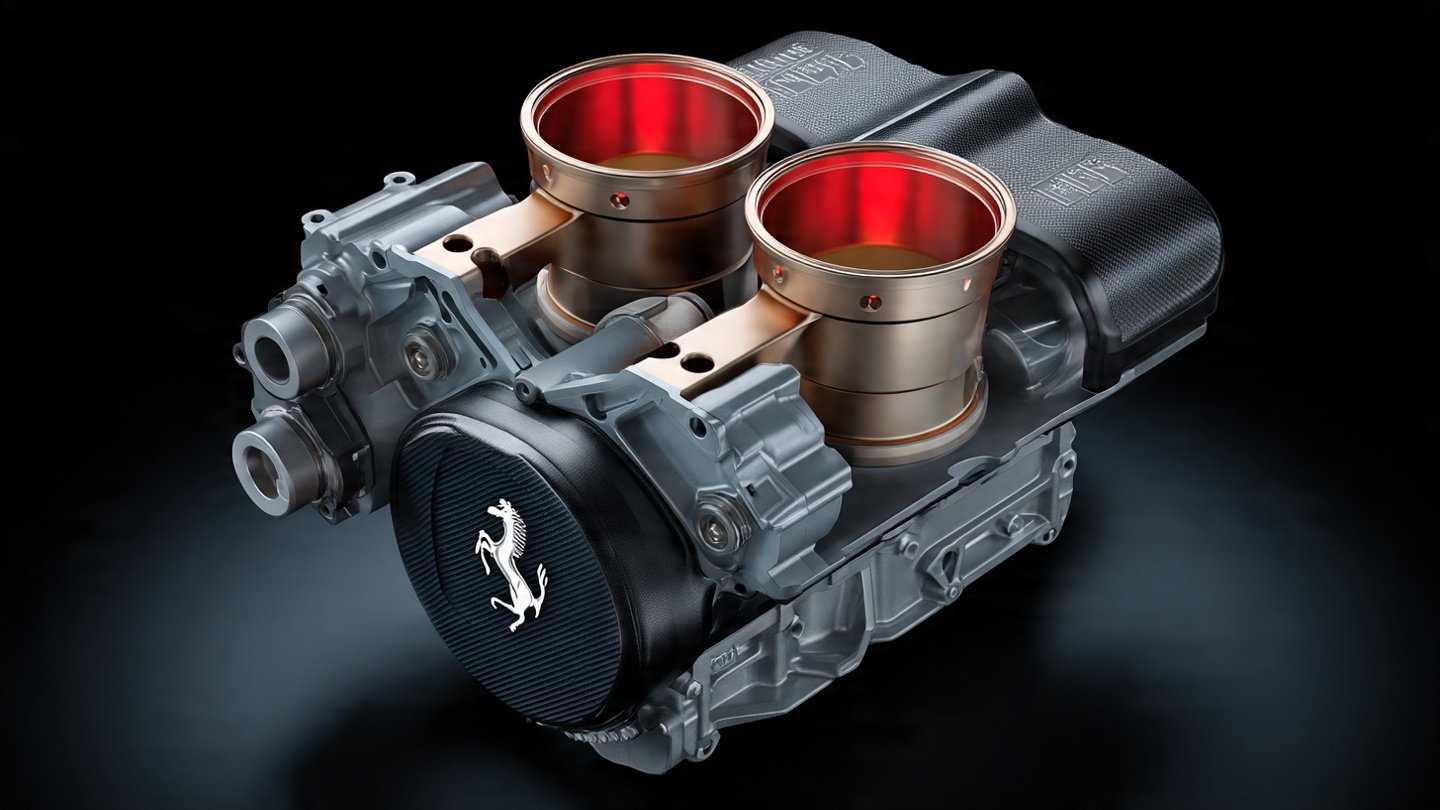
In a world where automotive engineering has long relied on familiar formulas and well‑worn designs, an innovation from Ferrari could signal a significant shift in how high‑performance engines are built. The company has recently revealed a radical piston design—oblong rather than circular—that its engineers believe could have profound effects on engine packaging, efficiency, and overall performance. While still at the patent and concept stage, this development is stirring excitement among enthusiasts and engineers alike because it challenges one of the most fundamental assumptions of internal combustion engine design.
Why Pistons Have Always Been Round
For over a century, pistons—a core component of nearly every internal combustion engine—have been round for one simple reason: ease of manufacture. Early engine builders relied on machining processes that made circular shapes the most practical and cost‑effective to produce and seal against cylinder walls. As a result, piston and bore geometry remained largely unchanged even as other engine technologies evolved.
However, what was easier to make in the early days of engine manufacturing may not be the most efficient shape given today’s advanced machining capabilities. Modern technology—like precision CNC machining and additive manufacturing—now allows engineers to rethink shapes once considered impractical or prohibitively expensive. Ferrari’s oblong piston concept exploits this new flexibility.
What Ferrari’s Oblong (Oval) Pistons Are
The pistons Ferrari has patented are more accurately described as oval or “stadium‑shaped”—a rounded rectangle rather than a traditional circle. This shape fundamentally changes how pistons fit within an engine block. In Ferrari’s design, the long axis of the ellipse lies perpendicular to the crankshaft, which contrasts with earlier oval piston attempts (such as the 1970s Honda NR motorcycle) that oriented their long axis parallel to the crankshaft.
By adopting this orientation, the shorter dimension of the piston can align parallel to the crankshaft. The result? A potentially shorter overall engine length compared with a conventional circular‑piston engine with the same displacement and cylinder count. This impacts not only packaging but also how an engine can be integrated into a vehicle’s layout.
Why This Could Matter for Performance
At first glance, the most obvious benefit of oblong pistons is space efficiency. In a high‑cylinder‑count engine—like a V12—the traditional layout requires significant length to accommodate all the cylinders and their pistons aligned in series. Ferrari’s oval piston design naturally compresses that layout because the flattened sides allow adjacent pistons to be stacked more closely without interference.
But space isn’t the only advantage. Engineers believe several performance‑related gains could flow from this rethought geometry:
- Lower frictional losses: The shape can reduce the surface area that rubs against the cylinder walls, potentially decreasing internal friction and improving efficiency.
- Improved combustion dynamics: An oblong piston could allow for more flexible valve placement or more total valve area, helping the engine “breathe” better—drawing in air and expelling exhaust more efficiently.
- Better thermal management: The unusual piston form might offer new ways to manage heat within the combustion chamber, a key factor in high‑performance and high‑efficiency engines.
Essentially, Ferrari isn’t just reshaping a component—it’s reimagining how the engine itself can operate.
Historical Attempts and Modern Revival
Ferrari is not the first to toy with alternative piston shapes. The most famous predecessor is Honda’s oval piston engine, featured in its NR500 Grand Prix race bike in the late 1970s. Motorsport engineers hoped that the larger piston surface area (effectively allowing more valves and better breathing) would yield higher performance. But the design faced significant reliability problems, particularly around sealing the piston rings—a challenge that ultimately limited its success.
Ferrari’s approach differs in key ways, including the orientation of the oval and modern engineering tools at its disposal that could address the sealing and machining challenges that plagued earlier designs. Whether these theoretical advantages can be realized in production engines remains to be seen, but the concept’s existence highlights Ferrari’s willingness to challenge tradition.
Engineering Challenges Ahead
Despite its potential, the oblong piston concept comes with serious hurdles before it can ever reach customers. Pistons must seal tightly against cylinder walls to maintain compression. With a circular piston, uniform pressure distribution helps the rings maintain that seal as the piston moves up and down. An oblong shape introduces variation in surface contact that could complicate sealing and wear patterns.
Manufacturing complexity is another concern. Rounded pistons have dominated because they were easy to make with traditional lathes and boring tools. Even with advanced CNC machines and 3D metal printing, creating high‑precision oval pistons at scale—and ensuring consistent quality—is a significant engineering challenge.
Additionally, connecting rods and crankshaft arrangements must be rethought to accommodate the new geometry. Ferrari’s patent outlines shared connecting rods and multi‑link systems to absorb the unusual forces generated by the oblong pistons, but these mechanisms add complexity and cost to the engine design.
Could This Save the Internal Combustion Engine?
Internal combustion engines are under intense pressure from global emissions regulations and rapid electrification across the automotive industry. While electric powertrains are increasingly dominant, high‑performance combustion engines still have passionate demand—especially in brands like Ferrari that build emotional value around engine sound and mechanical drama.
Ferrari’s oblong piston patent signals that the company still sees space for innovation within the piston engine world. If successful, the design could allow future engines to be more compact, efficient, and powerful, which could extend the relevance of gasoline engines in a hybrid or performance context.
However, patent filings don’t always become reality. Many companies file patents for speculative technology that never reaches production. Yet the very act of rethinking the piston shows Ferrari is exploring ways to push the limits of what internal combustion engines can do in the modern era.
Looking Ahead
For now, Ferrari’s oblong piston design stands as a fascinating concept—one that reminds the automotive world that innovation can come from revisiting even the most established engineering norms. Whether this design ends up in a future Ferrari V‑engine or inspires other manufacturers to experiment with their own geometry remains to be seen.
If engineering teams can overcome sealing, manufacturing, and cost challenges, the result could be a new chapter for the internal combustion engine—one where tradition meets bold reinvention. Until then, this patent stands as a testament to Ferrari’s engineering ethos: always pushing for performance without accepting limits.