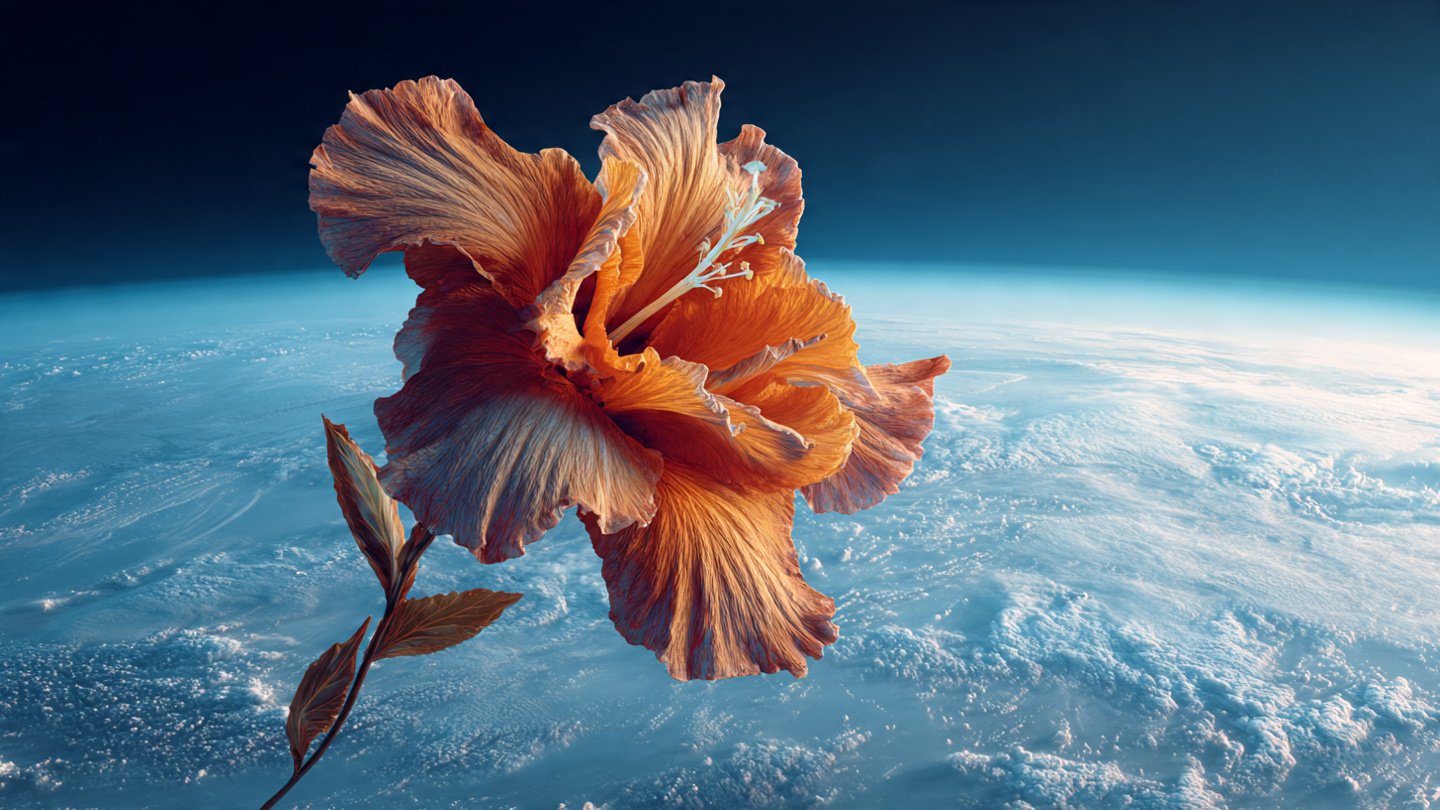
At first glance, sending a flower into space may seem symbolic or even whimsical. Yet this remarkable experiment fundamentally changed how scientists understand life, survival, and adaptation beyond Earth. When a flowering plant successfully grew in orbit, it became more than a scientific curiosity—it became proof that life can persist, adapt, and even reproduce in one of the most extreme environments imaginable.
This journey challenged long-held assumptions about biology, reshaped space research, and opened new possibilities for humanity’s future beyond our planet.
Why Send a Flower to Space?
For decades, scientists studied how microorganisms behaved in space. Bacteria, algae, and moss were relatively easy to grow in microgravity. Flowering plants, however, posed a far greater challenge. They have complex life cycles, rely on gravity for growth orientation, and are sensitive to environmental changes.
Researchers wanted to know: could a higher plant survive space conditions, flower normally, and complete its life cycle? The answer to this question held enormous implications—not just for science, but for long-term human space exploration.
Plants are essential to life support systems. They produce oxygen, recycle carbon dioxide, purify water, and provide food. If humans are to live on the Moon, Mars, or beyond, plants must be able to grow reliably in space.
The Challenges of Growing Flowers in Space
Space is an unforgiving environment. Microgravity disrupts how plants sense direction, causing roots and stems to grow unpredictably. Radiation exposure is significantly higher than on Earth. Water behaves differently, clinging to surfaces rather than flowing naturally through soil. Even pollination becomes complicated without gravity or insects.
Additionally, stress factors such as limited airflow and confined growth chambers can trigger disease or developmental abnormalities. Many scientists initially believed flowering plants would struggle to survive, let alone bloom.
The Historic Bloom in Orbit
Against these odds, a flowering plant was successfully grown aboard the International Space Station. After weeks of careful monitoring, astronauts observed something extraordinary: the plant produced healthy leaves—and eventually, a flower.
This moment marked a turning point. It demonstrated that complex life processes like flowering could occur in microgravity. The plant was not merely surviving; it was functioning as a complete organism.
What the Flower Taught Scientists
The space-grown flower revealed how adaptable life truly is. Researchers discovered that plants can rewire their genetic responses when gravity is absent. Instead of relying on gravitational cues, plants used light, moisture, and internal signaling pathways to guide growth.
This adaptability reshaped scientific thinking. Gravity, once thought to be indispensable for plant development, was revealed to be just one of several guiding factors. Life, it turns out, is far more flexible than previously believed.
The experiment also provided insights into how stress affects living organisms. Space-grown plants activated defense genes more strongly, offering clues about resilience, immunity, and stress tolerance—knowledge that could benefit agriculture on Earth.
Implications for Space Exploration
The success of flowering plants in space transformed mission planning. If plants can bloom in orbit, they can potentially be grown on long-duration missions, reducing dependence on resupply from Earth.
Future space habitats may rely on plants not only for food, but for psychological well-being. Studies show that caring for plants reduces stress and improves mental health—benefits that are invaluable for astronauts living in isolation.
On Mars or the Moon, plants may form the backbone of sustainable life-support systems, helping humans establish long-term settlements rather than temporary missions.
Lessons for Life on Earth
The flower’s journey into space also changed how we understand life on Earth. By studying how plants adapt in extreme environments, scientists gain insights into crop resilience under climate stress, drought, and poor soil conditions.
Space experiments have already influenced the development of hardier crops capable of surviving harsh conditions. In a world facing climate change and food insecurity, these lessons are increasingly vital.
The experiment also reinforced the interconnectedness of life. Even far from Earth, living organisms carry the blueprint of adaptation, growth, and renewal.
Redefining the Limits of Life
Perhaps the most profound impact of the flower’s journey was philosophical. It forced humanity to reconsider the limits of life. If a flowering plant can adapt to orbiting Earth at thousands of miles per hour, what else might be possible?
This realization fuels astrobiology—the search for life beyond Earth. If life is so adaptable, it increases the possibility that living organisms may exist elsewhere in the universe, even under conditions vastly different from our own.
A Symbol of Hope and Exploration
Beyond science, the flower became a powerful symbol. It represented hope, perseverance, and humanity’s innate desire to explore. Amid metal walls and advanced technology, something delicate and familiar thrived—reminding us that life belongs wherever curiosity takes it.
The image of a flower blooming in space resonated with people worldwide. It bridged the gap between science and emotion, turning a technical experiment into a shared human story.
The Future of Plants Beyond Earth
Since that first bloom, scientists have continued experimenting with different crops and flowering plants in space. Each success builds confidence that agriculture beyond Earth is not only possible, but achievable.
Future missions will refine growing systems, improve lighting and water delivery, and explore plant genetics tailored for space environments. What began as a single flower has grown into an entire field of research shaping humanity’s future among the stars.
Final Thoughts
The journey of a flower into space changed our understanding of life in ways few experiments ever have. It proved that complex organisms can adapt to microgravity, challenged assumptions about biological limits, and opened the door to sustainable human life beyond Earth.
More than a scientific milestone, the space-grown flower became a testament to life’s resilience. It reminded us that wherever humans venture—no matter how distant or unfamiliar—life has the potential to follow, adapt, and flourish.
Sometimes, it takes something as simple as a flower to reveal something extraordinary about the universe—and about ourselves.